Friday, July 22, 2016

Globe, Arizona, park features mining heritage, fitness trails

Raw copper ore
The old Dominion Historic Mine Park serves two purposes. One is to educate the public about the importance of mining in the Globe, Arizona, area. The other is to provide a series of fitness trails through the old mine site.

From 1880 to 1931, the Old Dominion Mine was a powerhouse in Globe’s copper mining industry, producing more than 765 million pounds of copper.

You’ll find pieces of old mining equipment scattered around the mine site. At the entrance, you’ll see a copper-studded boulder as well as a display of various types of rocks, each identified with a placard on the chain link fence.

Mining equipment on display
The park has trails for all levels of fitness. Non-motorized bicycles are allowed as well as wheelchairs and strollers.  The trails are not paved, just gravel and dirt. They are named for original mine claim owners at this location.

If you’re visiting on a hot summer day, be sure to have water with you. As you walk the trails, be on the lookout for rattlesnakes; I heard one in the bushes when we were there, but did not see it.

The park is open daily from dawn to dusk. Operated by the City of Globe, there are restrooms at the entrance; picnic facilities are available.

The park is located on Highway 60 in Globe. Turn on Murray Street by DeMarco’s Pizza and go up the hill.


.


Friday, July 8, 2016

Tubac, Arizona, building centers around art

Tubac Art Center
Tubac, Arizona, may have only about 2,000 residents, but it’s got a burgeoning art colony with more than 100 galleries, studios and boutiques. It’s no surprise, therefore, that it has its own art center.

The Tubac Art Center is operated by the Santa Cruz Valley Artists Association, which was founded with 80 members in the 1960s. Today, it has more than 850 members, only about a third who are from Tubac.

The center offers changing exhibits by both local and nationally known artists. It has room for art classes, workshops and other special events. A spring exhibit features work by local high school students.

The center is located in an adobe building at 9 Plaza Road. It is open daily. Admission is free.

Monday, June 27, 2016

Globe, Arizona, park showcases ancient Indian ruins

Besh Ba Gowah Archeological Park
Besh Ba Gowah is one of the more significant archeological finds of the Desert Southwest. The ruins were constructed by Native Americans at least eight centuries ago.

The people who built the 164-room stone structure were originally known as Hohokams, the same tribe that built an amazing irrigation system in 300 BC in Casa Grande, Arizona. The Globe, Arizona, Hohokams assimilated other native cultures into theirs so much so they lost their Hohokam identify. For lack of anything better, archeologists called them Salados. The Salados traded far and wide, often with tribes as far as a thousand miles away.  A collection of the Pacific Coast seashells they traded for can be seen at the on-site museum.

The Salados built a warren of rooms and buildings; some of the buildings were two stories high. Two of these buildings have been restored. Stones for the complex were hauled from nearby Pinal Creek. Except for the restored buildings, the remaining walls aren’t very high. Doorways are only a couple of feet high. Some of the rooms are small, while others are bigger. They were used as living quarters and for storage, among other uses. Today, some of the rooms are filled with wildflowers and cactus, rather than home furnishings, some of which you can see at the museum.

Globe was founded around 1875 as a mining camp. This resulted in the Apaches giving the place the name of Besh Ba Gowah, which translates as “metal camp.”

The Salados disappeared from Besh Ba Gowah around 1400 AD, about 50 years before the Hohokams disappeared from Casa Grande.

The on-site museum is small, but excellent. A 140minute video provides an introduction to the site. The museum displays artifacts, such as highly decorative pottery, found in the ruins. It also has a replica of what the ruins might have looked like when they were used by the Salados.

The City of Globe operates the museum and archeological park today. The museum is open daily from 9 a.m. to 4:30 p.m.; it is closed Thanksgiving, Christmas and New Year’s Day.  It’s located at 1324 South Jesse Hayes Road. Turn onto Saguaro Drive from Highway 60. Stay on the winding round for about 1.4 miles, then make a right turn onto Jesse Hays Road and follow the signs. There’s a city park with picnic facilities across the parking lot from the ruins.
 
See more pictures of Besh Ba Gowah on mty YouTube channel. https://youtu.be/8idhAn-17Hg.
 
Besh Ba Gowah ruins as they might have looked originally

Sunday, June 19, 2016

Be prepared for driving emergencies in the desert

Sonoran Desert
As my husband is fond of saying, southern Arizona has only five temperatures: hot, hotter, hottest, hot as hell and hotter than hell.

If you’re going to be spending any time here, even it’s just mostly driving through, you need to be prepared, especially in the summer. You never know when emergencies will crop up, which is something we learned the hard way.

We were traveling across the Sonoran Desert on Interstate 8 from Yuma to Tucson in late July one time. It was 125 degrees in the shade, only there was no shade on the freeway. Our pick-up broke down, shutting all electrical systems down, leaving us with no air conditioning or the ability to put the power windows down for any breeze that might come along. Since we were barely on the freeway shoulder, we could only open doors on the passenger side.

Luckily our cell phones were charged and we could get service.  When we called for roadside assistance, we were told it would be about two hours before help arrived almost 40 miles from the nearest town. It was so hot, we were both sweating so profusely, you could wring liquid out of our clothes. We had a cooler full of bottled water, so we could replace what we lost, but we couldn’t get our little dog to drink any. He gasped furiously for air, then collapsed, so still we thought we’d lost him.

More than an hour into our wait, a state patrolman stopped and insisted on taking us to a gas station four miles away where we could wait in shade for the tow truck. I shudder to think what would have happened to us if the patrolman hadn’t come along.

So what did we learn from this?

  • Make sure your car is in good working condition if you’re traveling through the desert in the heat of the day.  You can’t anticipate breakdowns, but if you know there’s something wrong with your vehicle, even if it seems minor, get it fixed before you start cross the desert. The repair shop said the part that broke, disabling our truck, rarely did so, but the breakdown turned a 3 -1/2 trip into one that lasted almost eight hours.
  • Make sure your cell phone is charged. My husband and I purposely use different cell service providers, just in case one of us can’t get service, the other one probably can.
  • Make sure you have a good roadside assistance plan and call for help immediately.
  • Make sure you have lots of bottled water, preferably in a cooler, with you. And drink lots of it. Becoming dehydrated will only add to your problems. Even if we’re just going to Tucson, 45 miles from where we live now, we’ll take a cooler containing 6-8 bottles of water with us.


Tuesday, June 7, 2016

Fort Apache: from 19th century fort to school

First Officer's Quarters
If you’re a fan of John Ford’s 1948 Western, Fort Apache or the 1950s kids; TV series, The Adventures of Rin Tin Tin, you’re in for a shock when you visit the real thing in the White Mountains of central Arizona.

Nothing remains of the original fort, established in 1870 as Camp Ord. Indeed, the oldest building in the complex is the First Officer’s Quarters, constructed in 1893. The ranch-style log cabin is now a museum devoted to the fort’s history. It was abandoned by the U.S. Army in 1922 and was turned into a boarding school for Indian children. A school still operates on the site today, though children are now bused in.

Plaques in front of the buildings explain what the buildings were used for in the days when the complex was a fort and boarding school.  The fort complex is now an historic site administered by the White Mountain Apaches.

The camp was renamed Camp Apache in 1871 to honor the Apache tribe. It was established to protect the White Mountain Reservation and the Indian agency. But soldiers soon found themselves embroiled in war for many years with these very same Indians. The unrest worsened in the next few years, heating up in 1876 when the government moved the Chiricahua Indians from Fort Bowie in southeastern Arizona to the San Carlos Reservation that adjoined the White Mountain Reservation.

Monument
War with the Indians went on for 15 years, finally ending with the capture of Geronimo in 1886. A monument to the soldiers killed at the August 30, 1881, battle of Cibicu Creek stands in the yard surrounding the First Officer’s Quarters.

Admission to the historic site  is charged; the fee also includes admission to the tribe’s nearby cultural center and the Kinibisha ruins.  

The cultural center is known as Nohwike' Bagowa or House of Our Footprints. It’s small but does a good job of explaining the history of the White Mountain Apaches. A video plays inside a wickiup, but the narrative is only in the tribe’s native language with English subtitles.


Fort Apache is located on Highway 73, a 24-mile detour off Highway 60/77 that connects Globe and Showlow.  Casual travelers may not think the detour is worth it. Fort Apache will appeal most to visitors with a strong interest in Native Americans and the Indian wars of the Old West.


Monday, May 23, 2016

Arizona's Salt River Canyon: awesome

Highway through Salt River Canyon
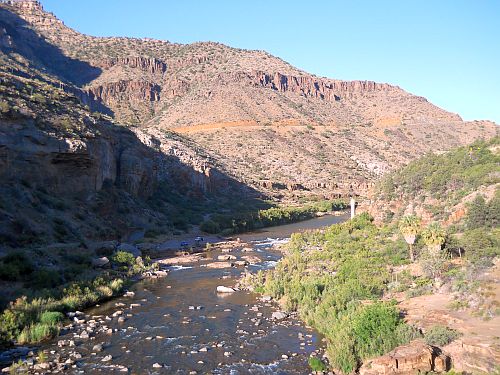
Arizona’s Salt River Canyon isn’t as deep, wide or long as its cousin to the north, the Grand Canyon, but it still is mighty impressive.

The Salt River Canyon is awesome! The views are spectacular. The canyon ranges in depth from 2,200 to more than 4,000 feet deep. The canyon is located in the White Mountains of central Arizona, about midway between Globe and Showlow on the very scenic Highway 60/77.

As the car drives, it’s nine miles from the top of one rim to the top on the other side. As the crow flies, it’s a heckuva lot shorter because they don’t have to drive down/up steep switchbacks with tight curves. Nor will they want to stop in mid-air to admire the view, though motorists will want to stop at some of the many viewpoints on the route.  The road has a 6 percent grade, so you’ll want to make sure your vehicle brakes are in good working order.

View from the pedestrian bridge
There’s a rest area at the bottom of the hill, with plenty of parking for those who want to do more than just use the restrooms (there’s no water available to wash hands).  A pedestrian bridge runs parallel to the vehicular bridge crossing the Salt River. Steps lead down to the river and trails.

The Salt River Canyon is part of a wilderness area administered by the U.S. Forest Service. The Forest Service says about 200 species of wildlife can be seen in the wilderness area; highway signs caution drivers to watch out for deer and elk.

Salt River Canyon

Thursday, May 12, 2016

American Flag Ranch: mine, post office, cattle ranch, museum

American Flag Ranch
territorial post office
The American Flag Ranch has a rich, varied history.  Located on a quiet road a few miles outside of Oracle, Arizona, it was founded in 1877 as the American Flag Mine.

The mine attracted hundreds of miners, not just to work at it, but alsothose who wanted to get rich with their own mines. This list included Buffalo Bill Cody who had a mine a couple of miles away at Campo Bonito.

A post office was established in 1880, back when Arizona was still a territory, Named the American Flag Post Office, it was located in a ranch building that is now the oldest territorial post office still standing in Arizona. The building was named to the National Register of Historical Buildings in 1979.

The mine eventually closed, and its founder, Isaac Lorraine, turned his property into a cattle ranch.

Owned today by the Oracle Historical Society, the ranch is now a museum. A key component is a central room filled with postal memorabilia, old photos and an exhibit on Oracle’s most famous miner, the Wild West showman, Buffalo Bill Cody.

The American Flag Ranch is open by appointment only. Call the Oracle Historical Society, (520) 896-9609 to make arrangements and get directions.