Monday, May 23, 2016

Arizona's Salt River Canyon: awesome

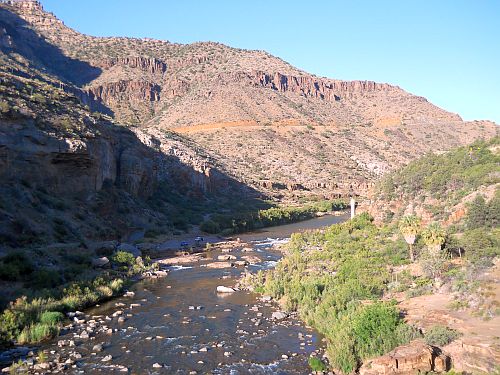
Highway through Salt River Canyon
Arizona’s Salt River Canyon isn’t as deep, wide or long as its cousin to the north, the Grand Canyon, but it still is mighty impressive.

The Salt River Canyon is awesome! The views are spectacular. The canyon ranges in depth from 2,200 to more than 4,000 feet deep. The canyon is located in the White Mountains of central Arizona, about midway between Globe and Showlow on the very scenic Highway 60/77.

As the car drives, it’s nine miles from the top of one rim to the top on the other side. As the crow flies, it’s a heckuva lot shorter because they don’t have to drive down/up steep switchbacks with tight curves. Nor will they want to stop in mid-air to admire the view, though motorists will want to stop at some of the many viewpoints on the route.  The road has a 6 percent grade, so you’ll want to make sure your vehicle brakes are in good working order.

View from the pedestrian bridge
There’s a rest area at the bottom of the hill, with plenty of parking for those who want to do more than just use the restrooms (there’s no water available to wash hands).  A pedestrian bridge runs parallel to the vehicular bridge crossing the Salt River. Steps lead down to the river and trails.

The Salt River Canyon is part of a wilderness area administered by the U.S. Forest Service. The Forest Service says about 200 species of wildlife can be seen in the wilderness area; highway signs caution drivers to watch out for deer and elk.

Salt River Canyon

Thursday, May 12, 2016

American Flag Ranch: mine, post office, cattle ranch, museum

American Flag Ranch
territorial post office
The American Flag Ranch has a rich, varied history.  Located on a quiet road a few miles outside of Oracle, Arizona, it was founded in 1877 as the American Flag Mine.

The mine attracted hundreds of miners, not just to work at it, but alsothose who wanted to get rich with their own mines. This list included Buffalo Bill Cody who had a mine a couple of miles away at Campo Bonito.

A post office was established in 1880, back when Arizona was still a territory, Named the American Flag Post Office, it was located in a ranch building that is now the oldest territorial post office still standing in Arizona. The building was named to the National Register of Historical Buildings in 1979.

The mine eventually closed, and its founder, Isaac Lorraine, turned his property into a cattle ranch.

Owned today by the Oracle Historical Society, the ranch is now a museum. A key component is a central room filled with postal memorabilia, old photos and an exhibit on Oracle’s most famous miner, the Wild West showman, Buffalo Bill Cody.

The American Flag Ranch is open by appointment only. Call the Oracle Historical Society, (520) 896-9609 to make arrangements and get directions.


Monday, February 8, 2016

Where to eat in Tucson


I read somewhere there are more than 1,800 restaurants in Tucson. With restaurants ranging from fast food to fine dining everywhere, that number is really believable. Plus, pick a cuisine and Tucson probably has a restaurant serving that style of food.

During our time in Tucson, we’ve sampled the food at quite a few restaurants, our favorites more than once. Here’s a list of restaurants that we’ve eaten at and can recommend.  The list is heavy on Northwest Tucson restaurants because that’s where we lived, but we’ve eaten at places all over the city.

·       Texas Roadhouse has several locations in Tucson, but we like the Texas Roadhouse at  8459 N. Cracker Barrel Road in Marana best. It has the best food and service. Take the Cortaro Road exit off Interstate 10.

·       Cattletown Steakhouse and Saloon is said to be the best steakhouse in Tucson. It has the crowds for the Saturday night steak special to prove it. It’s located at 3141 E. Drexel Road.

·       Panda One is a small restaurant serving Chinese food, including the best beef and broccoli I’ve eaten outside of China.  Don’t let the empty parking lot fool you – their food is good! There’ve been times when there’s only been a table or two of eat-in diners, but there’s a steady stream of people coming in for take-out. Panda One is located at 3670 N. Oracle Road.

·       Red Lobster has several locations in the Tucson area, but we like the one at 5061 B, Oracle Road best. The food and service are outstanding.  We’ve eaten at Red Lobsters in five states, and it doesn’t get any better than this Tucson location.

·       El Molinito has three locations in Tucson; we’ve only eaten at the one at 3675 W. Ina Road, but have been back several times. Their enchiladas are excellent.

·       Wisdom’s Dos is a good place to stop if you’ve spent a day exploring south of Tucson or shopping in Nogales, Mexico. It’s located at 4 Plaza Way in Tubac. They do a land office business with their cerviche; one taste and you’ll understand why. They automatically add a 15 percent tip to your bill for service, which seems to be pretty much non-existent, but they’ll take it off if you ask.

·       Frost is THE place to go for gelato. Their gelato is sinfully rich but lower in calories than regular ice cream.  Pick a flavor, any flavor, it’s all good. We’ve had gelato at two of their locations: 7131 N. Oracle Road and La Encantada Mall, 2905 E, Skyline Drive.

·       Sauce Pizza and Wine has three locations in Tucson. We’ve only been to the one at 7117 N. Oracle Road, which is right next door to Frost. The pizza is outstanding, with heavy crowds on weekends and evenings. Outdoor seating is available.

·       La Parilla Suiza is a chain of Mexican restaurants in Arizona. We have, however, only eaten at one of their three Tucson locations: 2720 N. Oracle Road. The restaurant specializes in the cuisine of Mexico City, not the Tex-Mex that I’m used to. It’s quite good, however, so we’ll go back.

·       The Curry Leaf is considered one of the best Indian restaurants in Tucson, and I have to agree with that assessment. Good food and good service are front and center at this small restaurant at 2510 E. Grant Road.


Monday, January 25, 2016

Casa Grande Ruins highlight early people's achievements

Casa Grande ruins
Ancient civilizations may have been primitive by our standards today, but they still accomplished some pretty amazing things.

Take, for example, the Hohokams, a prehistoric people who lived in the Sonora Desert.  Back in 300 BC, they built a canal system that was considered an engineering marvel in its day.  They used only primitive tools, digging a 220-mile canal system to bring water from the Gila and Salt rivers to their crops. The canals were deep enough that fish sometimes swam up them, providing another source of food. The remains of their canal system can be seen today at Casa Grande Ruins National Monument at Coolidge, Arizona.

The Hohokams were a self-sustaining people. They grew a variety of edible foods, including two corn crops a year; tobacco, and cotton, which they spun into thread and wove into clothes. They stored food and seeds in large decorative pottery containers. They hunted and they fished. They made fine jewelry.

In the 14th century, they built a huge adobe house that was 60 feet long and four stories high. They surrounded it with lesser walls. .In the 15th century, the Ancestral Sonora Desert People, as these Native Americans are known today, simply began to disappear. There was no one there by 1694 when Father Eusebio Kino came across this large house and compound. He called it “casa grande,” which means “great house.” Father Kino, a Jesuit from Italy, came to the New World with the Spanish in the 17th century, and explored the southwest, founding churches t Tumacacori and San Xavier del Bac, both south of Tucson.

The large house today is under a roof to protect it as much as possible from the elements. The adobe is cracked; support beams have been added to keep it standing as long as possible.

The ruins make a good day trip from Phoenix or Tucson and can easily be combined with a visit to St.Anthony’s Greek Orthodox Monastery.

The ruins are open from 9 a.m. to 5 p.m. seven days a week, though they are closed on Thanksgiving and Christmas days. Operated by the National Park Service, the ruins are located on Highway 87 just across from Safeway Plaza in Coolidge.

You can see more pictures of the ruins on my Youtube slideshow.


Saturday, January 23, 2016

Greek monastery is an oasis in the Arizona desert


St. Anthony's Church
Words like “awesome” and “fantastic” are not adequate to describe the beauty and serenity of St. Anthony’s Monastery in rural southern Arizona.  Not only is it an oasis in the desert, but, in these troubled times, it is an oasis for the soul. From the carefully landscaped gardens to the exquisite detail in the church and chapels, visitors can clearly see God’s artistic hands at work.

What the Greek Orthodox monks have accomplished in just over 20 years is nothing short of amazing. It is a miracle. Beginning in 1995, six monks have totally transformed this patch of the Sonora Desert.  The monks did much of the work themselves, but used construction contractors for work on the buildings. By 2016, the order counted 54 monks, but the work still is not finished. . Besides the lush greenery and buildings, the monks have an extensive citrus fruit orchard, growing a variety of fruit. They also have an olive grove and sell olives and olive oil made on the grounds in the church bookstore.

Monastery grounds
The monastery is named for St. Anthony the Great, who founded monasticism in the third century. This order of monks is affiliated with Mount Athos, a sacred place in northern Greece where their main monastery is located. The main church is dedicated to him as well as to Nectarios the Wonderworker. The other five chapels also are dedicated to saints: Seraphim of Sarov, Demetrios of Thessalonica, John the Baptist, George the Great Martyr, Nicholas the Wonderworker, and Panteleimon the Healer. Another chapel, dedicated to the Prophet Elias, is the white chapel on the hill that visitors see as they drive to the monetary located at the end of Paisano Road.

Visitors will stand in awe of the sanctuaries in the church and the chapels. Paintings of saints hang from the walls. Each chapel has a dome; hanging down through the center are intricately designed chandeliers that gleam in the sunlight that streams down from the dome.  These buildings have no pews, since monks stand during daily services. There are, however, tall chairs lining the sides of the church and chapels that visitors and those too tired to stand may use.

Pictures may be taken inside the church and chapels, as well as anywhere else on the grounds. Visitors are not, however, allowed to take pictures of the monks in their long black robes or the bishop’s chair.

Monastery grounds
The monastery has a strict dress code for visitors. Men must wear long pants and long-sleeved shirts. Women must wear head scarves and long skirts; scarves and elastic-waist skirts to put on over pants are provided for women who need them. Both sexes must wear socks (nylons are not acceptable) and proper shoes. Visitors may want to use the bathrooms behind the bookstore before setting out, as they are the only public restrooms in the complex.

Rules are explained at the guest house, and then visitors are allowed to wander through the complex at their own pace. The monks say it takes about 45 minutes to tour the main monastery grounds, but visitors who want to sit and enjoy the serenity of the lovely gardens obviously will take longer.
 
The monastery is handicap accessible with paved walkways. The parking lot, however, is gravel and there are a few steps in some of the buildings. 

The monastery is open to the public daily from 10:30 a.m. to 2:30 p.m. The monastery is located on Paisano Drive, eight miles south of Florence. Visitors coming from Phoenix/Florence on Highway 79 should turn onto Paisano just past milepost 124. Visitors coming up Highway 79 from Tucson will turn right onto Paisano just after milepost 123.  

More pictures of the monastery can be found on my Youtube channel.


Monday, January 18, 2016

Arizona Trail challenges hikers

If hiking is your passion, the Arizona Trail just might be your dream come true.

It’s an 800-mile trek that stretches from the border with Utah to the border with Mexico.  This non-motorized trail takes hikers through deserts and mountains, through all types of vegetation and ecosystems, with the opportunity to view lots of wildlife. It crosses the Grand Canyon as well as several mountain ranges.

The trail starts roughly a few miles east of Fredonia in the north and ends south of Sierra Vista. The trail can be hiked in either direction, though only a few people have done both ways.

The trail is divided into 43 segments, called passages. They range in length from 8.3 to 36 miles. Besides hikers, the trail also is open to mountain bikers and horseback riders.
  
Those who complete the entire length of the trail, either all at once or in segments, receive either a belt buckle or a pin from the Arizona Trail Association, which administers the trail.
 
The Arizona Trail runs through Colossal Cave Mountain Park east of Tucson. (picture below)

Sunday, January 10, 2016

United States dominates list of places to visit in 2016

If you're wondering where to go in 2016, the New York Times has some idea. It recently published a list of places to visit in the coming year. The United States dominated the list, with more places than any other country in the world. Mexico City topped the list.

The American buffalo
North Dakota's Theodore Roosevelt National Park ranked the highest of the 10  places in the United States that made the list. It came in at No.5 because  the former president did more than anyone to preserve this area, starting with a cattle ranch he founded in 1974. It's a good place to see badlands and, buffalo grazing on prairies. Remote, but well worth the trouble to get there.

No. 12 on the list is Park City, Utah, which is home to the United States' largest ski\resort at 7,300 acres when Park City Mountain Resort merged with nearby Canyons ski resort. The mega resort is known as Park City; the two resorts are linked by an eight-passenger gondola.

It may surprise some that Grand Rapids, Michigan, is on the list. It is, after all, famous for making furniture and Gerald Ford. But the Times chose it because of its dramatic transformation via urban renewal and its burgeoning art scene. Cornerstone of the revival is the Grand Rapids Downtown Market, 138,000 square feet devoted to food; the building itself was made of materials from the rundown buildings it replaced.  The city also is famous for ArtPrize, an annual competition of contemporary art that awards a half-million dollars in prizes. Not to be missed is the Frederik Meijer Garden & Sculpture part, which features work by famous artists, such as Rodin. Grand Rapids ranked 20th on the list.

No. 26 Washington, D.C., is already filled with historic monuments and museums. with the Times picking it this year before of a new museum opening in the fall. The Smithsonian, already famous for its outstanding collection of museums, is adding the National Museum of African American Museum this fall.

The Times calls Providence, Rhode Island, the East Coast's answer to Portland, Oregon. It's got famous new restaurants and the Creative Mile that is lined with sculptures that end in a new development that includes a riverfront park. It ranked No. 33 on the list.

East Bay, California, ranked No. 39 on  the list because of its fast-growing population as well as its fast-growing arts and food scene.  In Oakland, one of the East Bay communities, more than 300 restaurants and a dozen wineries have opened in recent years. Be sure to check out Spirits Alley where old Navy air hangers have been turned into breweries and wineries.

Most people have probably never heard of Rosine, Kentucky, No. 42; after all, it's only got 113 residents. It is, however, famous as the birthplace of bluegrass music. Jam sessions are held every Friday from March to December in an old barn that is a national landmark because it's said to be the place where bluegrass was invented by Bill Monroe. The small community hosts an annual bluegrass festival.

No. 46, St. Louis, Missouri, will open the National Blues Museum later this spring, the times noted, focusing on this music as the foundation for other music genres in this country. The city also is focusing on making its famous arch more accessible to the public in a major project that refreshes parks and promenades in the area.

Like the rest of Texas, Marfa, No. 48, does things in a big way. Take for instance, the Chinati Foundation, which showcases gigantic works of art by contemporary artists. To be unveiled this year is a 10,000-square piece by Robert Irwin. Other cultural events include music and film festivals.

Last on the list is scenic Beaufort, South Carolina, made the list because of its many amenities that range from restaurants and galleries to bike trials and benches overlooking the water. It also is noted for the reopening of a 250-year-0ld house, the Anchorage 1770, that in the 19th century was home to a literary club that focused on drinking, dancing and gambling.