Showing posts with label Tucson tourist attractions. Show all posts

Friday, April 3, 2015

Cheryl's top 10 list of Tucson attractions


Tucson has so many interesting things to see and do, it's difficult to cram them ll into a few days' visit. We stayed in Tucson for seven months, which gave us plenty of time to see its attractions, but we still didn't see everything the city has to offer.

Over the months, we visited dozens of attractions in and around the city. Picking out my favorites was a tough job, with strong competition coming from places such as Saguaro National Park, Rillito Farmers Market, Tohono Chul  and Arizona History Museum. Here’s a list of my top 10 favorite places to visit:

10. Pancho Villa statue: This impressive statue, located in a park in downtown Tucson, was controversial when it was given to the people of Arizona by the president of Mexico. Why? Because in the early 20th century, Pancho Villa was the only person to invade the United States and kill its citizens since the War of 1812.

9. Mt. Lemmon scenicdrive: When temperatures in Tucson get too hot, pack a picnic lunch and head up to Mt. Lemmon for stunning views of Tucson and miles beyond. The journey takes motorists through four ecosystems, from the deserts of Mexico to the pines of Canada. In the winter, it's southern Arizona's only ski area.

8. DeGrazia Gallery inthe Sun: Ted De Grazia was a multi-talented artist who worked with paints, clay, and even aluminum cans, He also was temperamental, once burning $250,000 worth of his paintings in a protest against inheritance tax laws.

7.Jewish History Museum: This small museum, located in Tucson's first synagogue, is considered one of the best Jewish history museums in the United States. One section is devoted to Tucson residents who survived the Holocaust.

6. Tucson PresidioMuseum: The museum stands on a portion of the original presidio where Tucson was founded in 1775. It's the place to be on the second Saturday of winter months for those who want to see "Spanish" soldiers fire muskets and sample fresh made tortillas cooked the old fashioned way.

5. Frost: Locations throughout Tucson serve up sinfully delicious gelatos that have fewer calories and fat than regular ice cream. This is where Tucson residents get their ice cream fix. We especially liked their store at Encantada Shopping mall, which is possibly one of the prettiest malls you’ll ever visit.

4. Mission San Xavierdel Bac: This centuries' old graceful white church is one of Tucson's icons, calling out to travelers along Interstate 19.

3. Pima Air & SpaceMuseum:  The largest private aircraft museum in the United States. It contains mostly military planes, with the space gallery containing a moon rock.

2. Old Tucson: Old Tucson is both a theme park and a movie studio, since more than 300 Western movies and TV shows were filmed here, ranging from McClintok! to Little House on the Prairie. We liked it so much, we went twice!

1. Arizona Sonora DesertMuseum: Perhaps Tucson's top-rated tourist attraction, and one of the world's top outdoor museums. With more than 40 acres of trails leading through the Sonora Desert, the museum is both a botanical garden and zoo.


Thursday, March 12, 2015

Visiting Tucson's frontier Army post, Fort Lowell

Remains of Fort Lowell hospital
The adobe remnants of an old 19th century Army post can still be seen today in Tucson.

The adobe has deteriorated since Fort Lowell was abandoned by the Army in 1891. Remains are covered by open sheds to protect them from the elements.

The fort is located where Tanque Verde and Pantano creeks join to form the Rillito River. The Hohokam tribe had lived there centuries earlier. Fort Lowell replaces an earlier Army installation, Camp Lowell that was located elsewhere in Tucson. The post is named after General Charles R. Lowell who died from wounds suffered at the Battle of Cedar Creek.

Fort Lowell was in active use between 1873 and 1891, and was key in protecting the Tucson area from Apache attacks. The post was a large complex, serving approximately 250 soldiers and officers. It had an extensive hospital, parts of which are standing today.

The Army decommissioned the post in 1891, with Mexican families moving in after that.

The remains today can be seen from behind chain link fences. It’s free to view them, but a museum nearby charges admission. The museum is administered by the Arizona Historical Society. The museum is open only on Fridays and Saturdays, though the grounds are open during the week.

The museum is located at 2900 N. Craycroft Road.


Thursday, March 5, 2015

Tucson toy train museum delights kids of all ages

Gadsden-Pacific Toy Train Museum
Kids of all ages will enjoy a visit to Tucson’s Gadsden-Pacific Division Toy Train Operating Museum. The best way to describe it is “cool.”
 
Seven huge tables are full of miniature towns, factories, oil refineries and mountains, with various types of trains running through them. Each table is devoted to a specific type of miniature train, ranging from N scale (the smallest) to large scale. Outside, there’s a real caboose to see and board.
 
The detail in each table’s contents is incredible. There are tiny people and cars, in period settings designed to complement the era of the train running down the tracks.  Each table has two or more trains running on their own tracks. Overhead, a larger train runs on tracks suspended from the ceiling.
 
Gadsden-Pacific Toy Train Museum
This model railroad museum is very kid-friendly. Plastic stepstools are provided so children can see the displays. Some displays are interactive. Push a red button, and a trolley comes out of a tunnel and moves around the track. Push another button and a dump truck operates in a rock quarry. Outside, a small train carries kids and adults on a ride around the property.
 
The museum is usually open the second and fourth Sundays of the month, but does close during June, July and August. You can call (520) 888-2222 to get their schedule. Admission is free, but donations are accepted, as this is a non-profit museum operated by volunteers.
 
No pun intended, but this fascinating little museum is located off the beaten track in Tucson.  It can be found at 3975 N, Miller Avenue. Take the Prince Road exit off Interstate 10, and then go left on Romero Street. Immediately past the stoplight at Roger Street, make a left turn onto Price Street, which dead ends at Miller. Turn left onto Miller.

Thursday, November 6, 2014

Tucson museum is a small, small world

A miniature village in the floor
It’s a small world.

If you don’t believe it, you need to visit the Mini-Time Machine Museum of Miniatures in Tucson. It’s a wonderland filled with miniature homes, furnishings, people, animals, etc., all designed to tempt your imagination,

The Array of miniatures is impressive, from houses to castles to a floating market in Thailand. Videos located throughout the museum offer information on everything from the history of miniatures to how to make mini silver tea sets.

Some of the miniatures have movable parts, such as trains going around a track. Some even have people waltzing on the balcony, such as the Wick House, made in the 1880s, that is typical of a Swiss house in the early 1800s. The multi-story house features workers on the bottom floor, soldiers enjoying a beer on the second floor and waltzers on the third floor, all moving at the same time.  The figures in the house are not moving today, but a video shows the mechanical figures in motion. The video shows a complicated system of pulleys, axles, wires, etc., that make the figures move.

A room in a miniature home
The museum has more than 275 houses, each completely furnished for the time period it is supposed to represent. They may look like doll houses, but no little girl would be allowed to play with them. These valuable houses are exquisitely done, and provide a most interesting peak into the past. And don’t forget the Enchanted Realm which displays miniature exhibits representing both fiction and folklore.

The miniature museum is located at 4455 East Camp Lowell Drive in Tucson. It is closed Mondays and major holidays.

Friday, October 24, 2014

Tucson museum preserves southern Arizona history

Arizona History Museum
Saving Arizona history is the task of the Arizona Historical Society and it does a mighty fee job of that at the Arizona History Museum in Tucson.

The museum concentrates on the history of southern Arizona, starting with the early Native Americans to the Spanish explorers and finally to territorial days.  Outside the front entrance is a marvelous statue of Father Kino, who build Catholic missions at Tumacacori and San Xavier del Bac.
 
The museum is packed full of artifacts from such diverse places as the bar from the Birdcage Saloon in Tombstone, an old stagecoach and a recreation of an Indian home. The museum does an excellent job of blending artifacts with photos. In the first building a brick wall leads into a photo of brick-making facilities.

Geronimo
A good portion of the second building is devoted to the mining history in Arizona Staff has even recreated an old mining tunnel, dark and narrow, to give you an idea of what working conditions for miners were like. A beautiful hand-stitched quilt stars in a display of vintage clothing and items of daily use. There’s also a stagecoach and an oxcart to show how people got around. One room is devoted to the Apache Indian chief, Geronimo.

The museum is located at 949 E. Second Street, near the University of Arizona campus. Free parking is available at the society’s parking garage one block west of the museum Be sure to take your parking stub with you so museum staff can validate the parking. 

The museum is open Monday through Saturday from 10 a.m. to 4 p.m. Plan on spending at least two hours here.

Thursday, July 31, 2014

Rural Tucson's graceful old mission


Mission San Xavier del Bac

The crisp white adobe stands out magnificently against the blue skies of the desert southwest. Guitars and voices ring out as a priest conducts mass inside the Mission San Xavier del Bac, located 10 miles south of Tucson, Arizona.

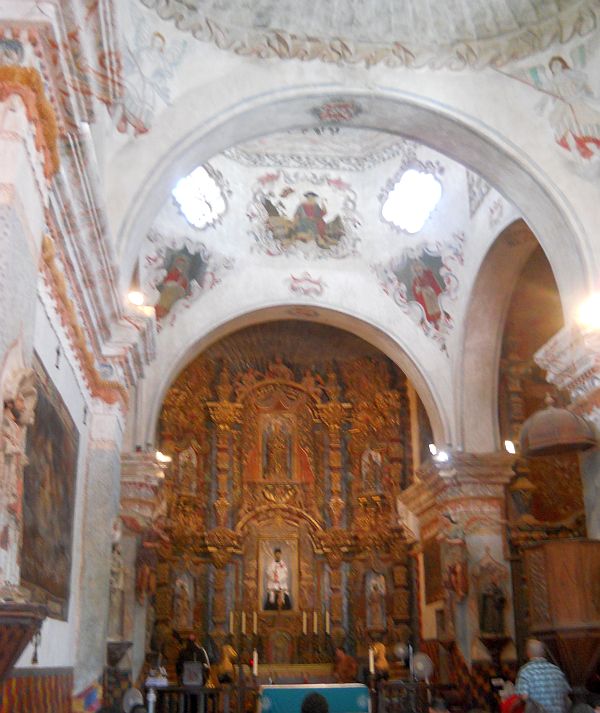
The mission was founded in 1692 by Father Eusebio Kino, a Jesuit. Construction on the current church stated in 1783 and ended fourteen years later The church, with its main entrance in wood, seems very large from the outside, but a lot narrower on the inside. The inside has the typical domed ceilings of Catholic cathedrals. The altar and backdrop are made of wood. Pews are a rustic wood.

A museum occupies several rooms to one side. These rooms were once used as sleeping quarters for the priests and nuns who ministered to their parishioners.

Inside the mission church
This section of Arizona was part of New Spain when the current church was built. The priest at the time borrowed money from a Sonoran farmer to pay for its construction. The mission is made of clay, brick and mortar. Cacti and other native vegetation fill a garden area in front.

San Xavier became part of Mexico when it declared its independence from Spain. San Xavier became part of the United States through the 1854 Gadsden Purchase. Nuns with the order of St. Joseph of Carondolet opened a school at the mission in 1872, The school is now operated by the Sisters of Charity.

The mission became a national historic landmark in 1963.

Sunday masses are at 7 a.m. and 10 a.m. Pictures may not be taken inside the church when mass is being held.

Admission to the church is free, though donation boxes abound. The church is located just off Interstate 19, which runs between Tucson and Nogales. The mission is visible from the freeway. Take exit 9 and follow the signs.