Showing posts with label things to see in Tucson. Show all posts

Friday, October 24, 2014

Tucson museum preserves southern Arizona history

Arizona History Museum
Saving Arizona history is the task of the Arizona Historical Society and it does a mighty fee job of that at the Arizona History Museum in Tucson.

The museum concentrates on the history of southern Arizona, starting with the early Native Americans to the Spanish explorers and finally to territorial days.  Outside the front entrance is a marvelous statue of Father Kino, who build Catholic missions at Tumacacori and San Xavier del Bac.
 
The museum is packed full of artifacts from such diverse places as the bar from the Birdcage Saloon in Tombstone, an old stagecoach and a recreation of an Indian home. The museum does an excellent job of blending artifacts with photos. In the first building a brick wall leads into a photo of brick-making facilities.

Geronimo
A good portion of the second building is devoted to the mining history in Arizona Staff has even recreated an old mining tunnel, dark and narrow, to give you an idea of what working conditions for miners were like. A beautiful hand-stitched quilt stars in a display of vintage clothing and items of daily use. There’s also a stagecoach and an oxcart to show how people got around. One room is devoted to the Apache Indian chief, Geronimo.

The museum is located at 949 E. Second Street, near the University of Arizona campus. Free parking is available at the society’s parking garage one block west of the museum Be sure to take your parking stub with you so museum staff can validate the parking. 

The museum is open Monday through Saturday from 10 a.m. to 4 p.m. Plan on spending at least two hours here.

Monday, October 6, 2014

A scenic drive up Tucson's Mount Lemmon

The view of Tucson below
If you’re looking for a pleasant drive that combines stunning scenery with the smell of pine trees, the Catalina scenic byway out of Tucson should fill the bill. It's considered one of the most scenic drives in the southwest.

The curvy road rises more than 8,000 feet as motorists scale the heights of Mount Lemmon that stands 9,157 feet in the Santa Catalina Mountains that flank one side of Tucson.  At the top, you’ll find the small village of Summerhaven with a couple of restaurants and a gift shop.

Just before dropping into Summerhaven, make a right turn to go to the Mt. Lemmon ski area. During the summer months, visitors can take a sky ride to the top of the mountain for ever more spectacular views. Be forewarned: parking is at a premium here, as well as in Summerhaven. Cars park on the

narrow shoulders and spill onto the narrow road, so caution navigating between the lines of cars is necessary.

The scenic drive through Coronado National Forest starts in the Sonora Desert; the cacti peter out about 4,000 feet in elevation. Next come a couple of thousand feet in elevation of shrubs and then tall, stately pine trees cover the mountains for the rest of the way. Pack a picnic lunch to enjoy at one of the picnic areas that start after the Palisades Visitor Center. The views are marvelous and the fragrance of the pine trees that fills the air is delicious. The U.S. Forest Service compares the journey to traveling from Mexico to Canada in just 27 miles.

View from Windy Point pullout
The road has plenty of pullouts and vistas where visitors can take in the breathtaking views. Public restrooms are available at Windy Point, then just south of the visitor center and a couple of miles north at Inspiration Rock picnic area. Trailheads, some with limited off-road parking, are plentiful.


Because of its twists and turns, the road is very popular with motorcyclists, so be on the lookout for them. Again, because of its curviness, the Forest Service does not recommend traveling the road in a large motorhome or pickup pulling a travel trailer longer than 22 feet. Motorists should make sure their vehicles have good brakes for the trip down. When the brakes start heating up, it may be advisable to pull off the road for awhile to let them cool down.

To reach the highway, take the Speedway exit off of I-10 and head northeast a few miles to Tanque Verde. Turn left on Tanque Verde to Catalina Highway. Stay on this rod until it becomes General Hitchcock Highway and enjoy the ride to the top.

See more photos of the Mount Lemmon scenic drive on my Youtube channel.


Tuesday, September 30, 2014

A visit to Saguaro National Park's eastern section


Sagauro National Park
If a pleasant walk in the desert suits your mood, then head to Saguaro National Park Rincon east of Tucson. The park has a quarter-mile Desert Ecology loop trail that takes strollers by a variety of cactus and other vegetation.

The trail has plenty of benches where armchair hikers can sit and enjoy the surroundings. It’s paved, which makes it wheelchair-accessible.

Visitors should be on the lookout for wildlife. The ranger at the entrance kiosk says any type of wildlife, from creepy crawlies on up, can be seen. We only saw birds and bees, but did see a couple of places where larger animals had burrowed into the ground around trees.  A few miles down the road, however, we did see a black tree snake as it crawled off the narrow one-way road.

An eight-mile road loops through this section of the park. It undulates as it slowly makes it way closer to the Rincon Mountains. There are plenty of places to pull off the road to enjoy the view or walk a less developed trail. The park has about 150 miles of trails. More adventuresome hikers might opt for a 12-15 trek to Manning Cabin, an old vacation cabin.

Saguaro National Park
Saguaro East teems with flora and fauna. The park is home to 25 varieties of cactus, 200 species of birds, 60 species of mammals and, of course, numerous reptiles, such as rattlesnakes and gila monsters.

Saguaro National Park is divided by the city of Tucson. The eastern section is known as Rincon Mountain District while the western portion is the Tucson Mountain District. The western section can be easily combined with a visit to the Arizona Sonora Desert Museum or Old Tucson, while the eastern section is an outing unto itself. It’s reached by taking the Broadway or 22nd Street exits from I-10. Head northeast for several miles, then make a right turn onto Old Spanish Trail and follow the signs.
 
For more photos of the park, see Saguaro National Park on my Youtube chnnel.


Sunday, September 21, 2014

Tucson farmers market spsecializes in heirloom veggies

Rillito Farmers Market

Bring lots of money when you visit the Rillito Farmers Market in Tucson. Vendors offer plenty of free samples, and resisting the temptation to buy everything you try is a gargantuan task.

Varieties of heirloom tomatoes
More than 65 vendors offer fresh heirloom fruits and vegetables, as well as homemade baked goods, chemical-free meats, organic salsas, cheeses and nuts, and other organic products such as soaps and lotions

The Rillito market takes place every Sunday morning throughout the year at Rillito Park, 4502 N. First Avenue.

The market moved to its own pavilion in the park in October 2014from its former location near the grandstand. A month after the move, the market had already outgrown the three long, narrow open-sided pavilions, with many new vendors in all categories.

Heirloom peppers
The Rillito farmers market is one of three heirloom farmers markets in this section of Arizona. There’s one on Fridays at Tucson’s Jesse Owens Park and another on Saturdays in Oro Valley, north of Tucson.


Tuesday, September 16, 2014

Pima Air & Space Museum: awesome!


Inside Hangar 3


A word of advice if you’re planning to visit the Pima Air and Space Museum in rural Tucson: go early. This isn’t a warning to go early to avoid the crowds. Rather, it is a warning to go early so you’ll have enough time to see this marvelous facility.

Some of the planes outside
We spent five hours at this 80-acre facility, and still didn’t see everything. The average visitor spends four to five hours, a ticket seller told us, noting visitors who are really fascinated with aviation usually buy a two-day pass. The museum is one of the largest aviation museums in the world, and the largest one that is privately funded.

In five hours, you’ll probably only be able to tour the space building and four hangers. Most of the planes, however, are outside and you’ll only see a small fraction of them as you walk between the buildings..

Believe me, this is not a place you’ll want to rush right through. The museum boasts more than 300 planes of every description and associated memorabilia. The planes are either on loan or were donated to the museum. For example, mostly military planes fill the four hangars; the military retains the ownership of the planes.

The main hangar is where visitors enter and leave the museum. It is chock-full of planes of all sizes. Two hangars are devoted to World War II planes. The space museum has a docking simulator, a portrait gallery of Arizonans who played active roles in this country’s aviation programs, and displays a moon rock. Another hangar/building is a stand-alone museum honoring the 390th Air Force wing and starring a B-17 Flying Fortress from World War II.
 
Inside the main hangar
All facilities have interactive or hands-on exhibits, like sitting in a plane’s cockpit. There’s also ample opportunity for kids to have their pictures taken “flying” miniature wooden aircraft.

The museum charges admission; optional guided tours are an additional cost. It is open daily from 9 a.m. to 5 p.m. The Pima Air and Space Museum is located at 6000 E. Valencia Road. To get there, take Interstate 10 east toward El Paso, exiting at Valencia Road. Follow the signs from there.

The museum is handicapped accessible, with push wheelchairs and walkers that can be borrowed.  These work fine inside the buildings or on a few asphalt paths that connect some buildings, but are difficult to push elsewhere outside where gravel and dirt surfaces prevail.

A final word of advice: Take plenty of bottled water with you. Water fountains are available throughout the facility, but that water tastes highly chlorinated after drinking the bottled stuff.

More pictures of the air and space museum can be found on my Youtube channel.

Tuesday, August 26, 2014

Tucson zoo home to animals from around the world

Children's play area
If you’re traveling with children, a visit to the Reid Park Zoo will make their day. The zoo has about 500 animals, including birds and reptiles, that are housed in settings as close to their native habitat as you can find in southwest Arizona.

The zoo is home to animals from around the world, from Africa to Asia to South America. Offerings include feeding a giraffe (an extra fee), a children’s African-themed play area, and an interactive area at the conservation learning center. Other activities to come in closer contact with the animals change on a daily basis.
 
Snack time
The zoo, founded in 1965, is involved in several wildlife conservation and breeding programs. Visitors may see lion cubs at play; the birth of a baby elephant is anticipated with eagerness when we were there.

The Tucson zoo is not the best zoo in the world, nor is it the worst.  It is what it is. A nice small zoo that gives locals the opportunity to see animals from other parts of the world. It's a small zoo as zoos go, and its animals appear to be well cared for. The zoo has plenty of benches where visitors can rest from all the walking; unfortunately, most of the benches face away from the animals. Also, on the day we were there, dirty windows and glass panels prevented visitors from being able to see the animals clearly. Aside from this, the zoo is a pleasant way to spend a few hours.

 The zoo is located at 3400 Zoo Court, just off 22nd. Go early, though, especially during the hot summer months. We arrived 45 minutes after the zoo opened to find the main parking lot was almost full.

Thursday, August 21, 2014

Old locomotive stars at Tucson nuseun

Wheel of Locomotive #1673
The Southern Arizona Transportation Museum is a small museum located at the former Southern Pacific Railroad depot in central Tucson.

The star of the museum is Locomotive #1673 that was built in New York in 1900. It was converted from burning coal to oil in 1906, and put into service by Southern Pacific Railroad. It racked up about a million miles hauling freight, mostly in the southern Arizona region.

The locomotive also starred in the movie Oklahoma when it was made in 1954, as well as in Tucson’s celebration of the 75th anniversary of the arrival of Southern Pacific in Arizona in 1955.  The locomotive was given to the City of Tucson following the celebration.

China used in dining cars
Today it has been cosmetically restored and inside a chain link fence on depot grounds.  The gate is locked, but if you ask at the museum, an attendant will unlock the gate so you can climb onto the engine. Today’s wannabe train engineers, he says, have it much cooler than the original men who drove the train. That’s because temperatures inside the cab could reach up to 150 degrees going down the tracks. This is why people always saw the engineers hanging out the side windows, he explains.

The museum proper is located in a small building known as the records building. It contains memorabilia, including china dishes used in dining cars and signal equipment. A miniature train circles the room from just below the ceiling.

The museum is open limited hours every day but Monday. Admission is free, though donations are suggested. It is located at 414 N. Toole Avenue. Parking is limited. The museum’s website says parking is free, but we only saw parking meters there.

Monday, August 18, 2014

Tucson museum showcases international wildlife

Diorama about mountain animals
Visiting the International Wildlife Museum is almost like visiting a real zoo, only the animals aren’t alive any more. Many of them, however, are placed in dioramas that reflect their native habitat.

Located in rural Tucson, Arizona, the museum is home to more than 400 species of animals, birds and insects. The museum’s website notes that all the animals found inside the huge stone building were donated by such organizations as government agencies, zoos and wildlife rehab centers.

A walk through the museum begins with viewing some gorgeous butterfly specimens mounted under glass. There also are moths so large, it is unbelievable. There are animals from all over the world, even at least one that is no longer part of this world. That’s a HUGE woolly mammoth that roamed the earth thousands of years ago.
 
Interactive kiosks make learning fun
Interactive kiosks that test one’s knowledge of the animal world can be found inside the museum. Some of the exhibits may not be suitable for young children or anyone who is squeamish because they present realistic scenes of predators killing their dinner in the wild. Just walk swiftly by these dioramas to ones that show parent animals caring for their young.

The museum, founded in 1988, is affiliated with the Safari Club International Foundation. It is open daily and charges admission. It is located at 4800 W. Gates Pass Road in Tucson. The easiest way to get there is to take the Speedway exit off Interstate 10, and stay on Speedway, which eventually turns into Gates Pass Road.

Friday, August 15, 2014

National park honors iconic cactus

Saguaro National Park landscape
The Saguaro cactus stand tall and proud in this section of the Sonora Desert, reminding us of fir and pine trees in a forest.

Saguaro National Park was established in 1933 to protect and preserve these symbols of the American West as this cactus is found only in a small area of the desert that surrounds Tucson, Arizona. Tucson itself separates the national park. The west section is known as the Tucson Mountain District while the east park section is known as Rincon Mountain District.

View from the visitor center
The west district that we visited isn’t just desert, but also contains mountains more than 4,600 feet high. (Mountains more than 8.600 feet high can be found at Rincon.) Desert scrub and grass lands lie at the base of the mountains.

The Saguaro is the nation’s largest cactus and they’re visible almost as far as the eye can see. Other varieties of cactus, including the ocotillo, can be found there, though the Saguaro dominates the landscape. Its blossoms are the Arizona state flower.

Wild animals, including coyotes, desert tortoises and a variety of rattlesnakes, can be seen in the park.

The west section offers a five-mile gravel loop road giving visitors a glimpse of the park. There also are hiking trails, though walkers should be on the lookout for rattlesnakes during the hot months. Hikers also should be sure to carry lots of water with them.

Tucson Mountain visitor center
The park is open to vehicles from sunrise to sunset daily, though hikers and bikers can use the park around the clock. Camping is not available. Both park sections have visitor centers that are open from 9 a.m. to 5 p.m. daily.

The Tucson Mountain District might be considered the poor man’s Arizona Sonora Desert Museum. That museum, located just a couple of miles away, charged admission of almost $20 per person per visit in 2014. The national park charges just $10 per vehicle for a weekly pass. The landscape isn’t that much different, though the desert museum several indoor exhibits in air-conditioned buildings.

The Tucson Mountain District can be reached by taking the Speedway exit off Interstate 10 in Tucson and heading south. Follow the signs to the desert museum, only keep going past the museum turnoff.

For more photos of the park, please see my Saguaro National Park slideshow.

Monday, August 11, 2014

A walk through the desert southwest

The Sonora Desert

The Sonora Desert Museum
Visiting Tucson without going to the Arizona Sonora Desert Museum is like going to Yuma but not visiting the Territorial Museum or to China without visiting the Great Wall.  The Sonora Desert Museum is one of those must-sees, without which your trip to Tucson would be incomplete.

Located about 15 miles south and west of Tucson on a scenic winding road through the mountains, the museum is a wonderful introduction to the desert southwest. It’s a botanical garden, natural history museum and zoo, all rolled into one.
It has buildings that house special exhibits such as an aquarium, and reptile, cat and hummingbird houses. But it is the two-mile walk through the desert that will captivate you. The outdoor museum covers 21 acres, and is home to 250 animal species and 1,200 varieties of plants. The views across the valley to the mountains beyond are nothing short of spectacular.
 
Sonora cactus
The museum is considered an international role model for presenting and interpreting nature in realistic exhibits. It was founded in 1952.

The Sonora Desert stretches from southern California through southern Arizona and into Baja California, about 200,000 acres in all. Most of the desert lies in Mexico. The desert is surprisingly green in the Tucson area, possibly because of nightly rains in the summer.
The museum has a live mountain lion and bear behind barriers, but mostly any small wildlife you come across will be running free. Several species of lizards about as do butterflies in a special butterfly garden.  Summer visitors will want to be on the lookout for rattlesnakes, especially if they are stupid enough to go off the path, which is not allowed in the first place.
 
A path through desert greenery
The best way to see the museum is to walk at an easy pace. Summer visitors will want to carry bottled water with them. Don’t worry about running out if you drink too much. You can always refill the bottle with cold water at one of the numerous fountains located along the route. The museum also provides plenty of shaded seating areas where you can rest and enjoy the view.

The outdoor route is handicapped accessible, but be forewarned, most of the paths are dirt and gravel. Push wheelchairs are available on a first-come first serve basis; mobility scooters are available for rent.
Cacti grow tall in the desert
The museum is open 365 days a year. It is located at 2021 N. Kinney Road in Tucson. The easiest way to get there is to take the Speedway exit off Interstate 10 and follow the signs through the mountains.

Admission was approximately $20 per adult in 2014. Visitors who have a Tucson Visitor Center attractions passport, which cost $18 in 2014 and is good for dozens of attractions in the Tucson area, can get one free admission with one paid admission.


Saturday, August 9, 2014

Biosphere 2 is a unique experience

Outside of Biosphere 2
Biosphere 2 is a must-see for wannabe scientists who are interested in earth science.
 
The facility, located in Oracle, Arizona, is a research facility that explores how water interacts with the rest of nature. The glass-enclosed facility is divided into six regions, called biomes: desert, rainforest, savanna, ocean, marsh and thornscrub. Each region looks just as it would if you saw it in a natural outdoors setting. It is, in fact, a replica of the earth’s environment. The original intent was to see if humans could live on Mars or the moon.
 
Construction of Biosphere 2 – so named because scientists consider Earth to be Biosphere 1 – started in 1987 as a private venture. The University of Arizona acquired it in 2011 and uses it as a research facility.
 
Inside Biosphere 2
The facility made news back in 1991 when eight people went to live inside the biosphere to see if human life could be sustained in a closed environment. They grew their own crops. Water was recirculated throughout the system, with most of the electricity being provided by solar panels. The enclosed living experiment ended with a dispute over finances in September 1994.
 
Though its primary purpose remains a research facility, Biosphere 2 is open to the public daily for guided tours. The tours cover about a mile, both inside and outside the facility, and a total of 150 steps. The outside portion of the tours wheelchair-accessible, but people with mobility problems are not allowed inside the facility.
 
Admission to the facility costs $20 for adults in 2014. People who will be doing only the outside of the facility pay the same price as those who take the full tour. About 1,000 people a day visit Biosphere 2 in the winter months, about 150 daily during the summer.
 
Biosphere 2 is located at the base of the Santa Catalina Mountains, a 30-mile drive north of Tucson on Highway 77. It is about a two-hour drive from Phoenix. To get there from Phoenix, take exit 185 off Interstate 10, then Highway 387 and pick up Highway 79 at Florence. Connect with Highway 77 at Oracle Junction and follow the signs.
 
- Photos by Jon Teal

Thursday, August 7, 2014

Pancho Villa rides again!

Controversial Pancho Villa statue
A huge bronze statue of a rider and his horse in action stands peacefully in a downtown Tucson park. One would never guess the controversy that surrounded this serene scene.

The rider is Pancho Villa, a Mexican revolutionary who some have called a Robin Hood because he distributed the wealth of rich Mexicans to that country’s poor. Others have described his actions as brutal, not heroic.

The statue stands in the 20 de Agosto Park, so named in honor of Tucson’s founding on August 20, 1775. It was a gift to the people of Arizona from the president of Mexico in 1981, but the gift sparked lawsuits and controversy from the beginning. It was not dedicated until the late 1980s.

A city near Phoenix rejected it, which is how it ended up in Tucson. The then-mayor of the city refused to attend the dedication, though a thousand other people did. Protests were held for the first couple of years on the dedication date because people did not think a person who killed Americans on American soil should be honored.

Pancho Villa was the first person since the War of 1812 with Great Britain to have invaded the United States and killed its citizens. Villa and his army crossed the border in southern Arizona where they killed residents of the border towns. However, he is most reviled for killing 18 Americans in a raid in Columbus, New Mexico, in 1916.

Villa was born José Doroteo Arango Arámbula in 1878, later adopting the name Francisco “Pancho” Villa. He was a general in the Mexican Revolution.

Controversy aside, the bronze statue is nothing but magnificent. It stands 14 feet tall and weighs seven tons.

The park is located at West Broadway and West Congress streets in Tucson’s city center.


Tuesday, August 5, 2014

Missile museum recalls Cold War

The "red safe"
Those of us who were growing up in the ‘60s can remember well how scary that time during the Cold War was. After all, at any time the Soviet Union could attack us and blow the United States off the world map.  We endured air raid warnings and being told we needed bomb shelters in our homes.

The Titan Missile Museum in Green Valley, Arizona, offers a chance to relive those years as well as remind younger generations what their elders went through.

Now a national historic landmark, this Titan missile site is the only one of the 54 sites remaining today. The sites, located across the United States, were on alert from 1963 to 1987. A Titan missile could be launched in 58 seconds, and could travel 6,300 miles in half an hour.

The main floor of the museum is filled with newspaper pages with headlines that shouted out news about the Cold War. There also is some equipment, such as a “red safe,” where the launch codes and keys were kept, on display.

This part of the museum is free. To see more, visitors will need to take a guided tour for which a fee is charged. The museum accepts the Tucson Passport for this tour. The tour takes visitors to the underground launch center where they’ll learn how the launch system works, as well as the safeguards used to prevent the unnecessary launching of the missile.  Visitors also be able to see a missile in its silo. The guided tour is handicap accessible, with an elevator to take mobility-challenged visitors up and down. 

The missile museum is located about 25 miles south of Tucson. Take Exit 69 (Duval Mine Road) off Interstate 19 and follow the signs. The museum is open every day except Thanksgiving and Christmas days.

Thursday, July 31, 2014

Rural Tucson's graceful old mission


Mission San Xavier del Bac

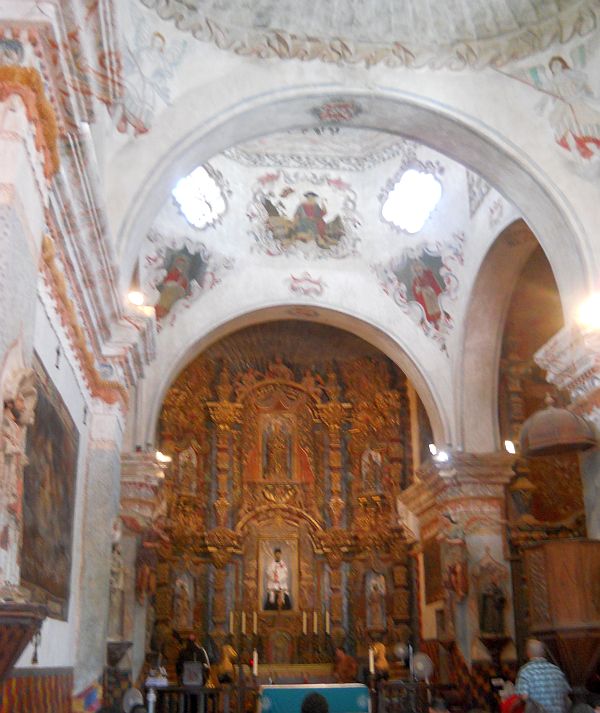
The crisp white adobe stands out magnificently against the blue skies of the desert southwest. Guitars and voices ring out as a priest conducts mass inside the Mission San Xavier del Bac, located 10 miles south of Tucson, Arizona.

The mission was founded in 1692 by Father Eusebio Kino, a Jesuit. Construction on the current church stated in 1783 and ended fourteen years later The church, with its main entrance in wood, seems very large from the outside, but a lot narrower on the inside. The inside has the typical domed ceilings of Catholic cathedrals. The altar and backdrop are made of wood. Pews are a rustic wood.

A museum occupies several rooms to one side. These rooms were once used as sleeping quarters for the priests and nuns who ministered to their parishioners.

Inside the mission church
This section of Arizona was part of New Spain when the current church was built. The priest at the time borrowed money from a Sonoran farmer to pay for its construction. The mission is made of clay, brick and mortar. Cacti and other native vegetation fill a garden area in front.

San Xavier became part of Mexico when it declared its independence from Spain. San Xavier became part of the United States through the 1854 Gadsden Purchase. Nuns with the order of St. Joseph of Carondolet opened a school at the mission in 1872, The school is now operated by the Sisters of Charity.

The mission became a national historic landmark in 1963.

Sunday masses are at 7 a.m. and 10 a.m. Pictures may not be taken inside the church when mass is being held.

Admission to the church is free, though donation boxes abound. The church is located just off Interstate 19, which runs between Tucson and Nogales. The mission is visible from the freeway. Take exit 9 and follow the signs.