Monday, August 11, 2014

A walk through the desert southwest

The Sonora Desert

The Sonora Desert Museum
Visiting Tucson without going to the Arizona Sonora Desert Museum is like going to Yuma but not visiting the Territorial Museum or to China without visiting the Great Wall.  The Sonora Desert Museum is one of those must-sees, without which your trip to Tucson would be incomplete.

Located about 15 miles south and west of Tucson on a scenic winding road through the mountains, the museum is a wonderful introduction to the desert southwest. It’s a botanical garden, natural history museum and zoo, all rolled into one.
It has buildings that house special exhibits such as an aquarium, and reptile, cat and hummingbird houses. But it is the two-mile walk through the desert that will captivate you. The outdoor museum covers 21 acres, and is home to 250 animal species and 1,200 varieties of plants. The views across the valley to the mountains beyond are nothing short of spectacular.
 
Sonora cactus
The museum is considered an international role model for presenting and interpreting nature in realistic exhibits. It was founded in 1952.

The Sonora Desert stretches from southern California through southern Arizona and into Baja California, about 200,000 acres in all. Most of the desert lies in Mexico. The desert is surprisingly green in the Tucson area, possibly because of nightly rains in the summer.
The museum has a live mountain lion and bear behind barriers, but mostly any small wildlife you come across will be running free. Several species of lizards about as do butterflies in a special butterfly garden.  Summer visitors will want to be on the lookout for rattlesnakes, especially if they are stupid enough to go off the path, which is not allowed in the first place.
 
A path through desert greenery
The best way to see the museum is to walk at an easy pace. Summer visitors will want to carry bottled water with them. Don’t worry about running out if you drink too much. You can always refill the bottle with cold water at one of the numerous fountains located along the route. The museum also provides plenty of shaded seating areas where you can rest and enjoy the view.

The outdoor route is handicapped accessible, but be forewarned, most of the paths are dirt and gravel. Push wheelchairs are available on a first-come first serve basis; mobility scooters are available for rent.
Cacti grow tall in the desert
The museum is open 365 days a year. It is located at 2021 N. Kinney Road in Tucson. The easiest way to get there is to take the Speedway exit off Interstate 10 and follow the signs through the mountains.

Admission was approximately $20 per adult in 2014. Visitors who have a Tucson Visitor Center attractions passport, which cost $18 in 2014 and is good for dozens of attractions in the Tucson area, can get one free admission with one paid admission.


Saturday, August 9, 2014

Biosphere 2 is a unique experience

Outside of Biosphere 2
Biosphere 2 is a must-see for wannabe scientists who are interested in earth science.
 
The facility, located in Oracle, Arizona, is a research facility that explores how water interacts with the rest of nature. The glass-enclosed facility is divided into six regions, called biomes: desert, rainforest, savanna, ocean, marsh and thornscrub. Each region looks just as it would if you saw it in a natural outdoors setting. It is, in fact, a replica of the earth’s environment. The original intent was to see if humans could live on Mars or the moon.
 
Construction of Biosphere 2 – so named because scientists consider Earth to be Biosphere 1 – started in 1987 as a private venture. The University of Arizona acquired it in 2011 and uses it as a research facility.
 
Inside Biosphere 2
The facility made news back in 1991 when eight people went to live inside the biosphere to see if human life could be sustained in a closed environment. They grew their own crops. Water was recirculated throughout the system, with most of the electricity being provided by solar panels. The enclosed living experiment ended with a dispute over finances in September 1994.
 
Though its primary purpose remains a research facility, Biosphere 2 is open to the public daily for guided tours. The tours cover about a mile, both inside and outside the facility, and a total of 150 steps. The outside portion of the tours wheelchair-accessible, but people with mobility problems are not allowed inside the facility.
 
Admission to the facility costs $20 for adults in 2014. People who will be doing only the outside of the facility pay the same price as those who take the full tour. About 1,000 people a day visit Biosphere 2 in the winter months, about 150 daily during the summer.
 
Biosphere 2 is located at the base of the Santa Catalina Mountains, a 30-mile drive north of Tucson on Highway 77. It is about a two-hour drive from Phoenix. To get there from Phoenix, take exit 185 off Interstate 10, then Highway 387 and pick up Highway 79 at Florence. Connect with Highway 77 at Oracle Junction and follow the signs.
 
- Photos by Jon Teal

Thursday, August 7, 2014

Pancho Villa rides again!

Controversial Pancho Villa statue
A huge bronze statue of a rider and his horse in action stands peacefully in a downtown Tucson park. One would never guess the controversy that surrounded this serene scene.

The rider is Pancho Villa, a Mexican revolutionary who some have called a Robin Hood because he distributed the wealth of rich Mexicans to that country’s poor. Others have described his actions as brutal, not heroic.

The statue stands in the 20 de Agosto Park, so named in honor of Tucson’s founding on August 20, 1775. It was a gift to the people of Arizona from the president of Mexico in 1981, but the gift sparked lawsuits and controversy from the beginning. It was not dedicated until the late 1980s.

A city near Phoenix rejected it, which is how it ended up in Tucson. The then-mayor of the city refused to attend the dedication, though a thousand other people did. Protests were held for the first couple of years on the dedication date because people did not think a person who killed Americans on American soil should be honored.

Pancho Villa was the first person since the War of 1812 with Great Britain to have invaded the United States and killed its citizens. Villa and his army crossed the border in southern Arizona where they killed residents of the border towns. However, he is most reviled for killing 18 Americans in a raid in Columbus, New Mexico, in 1916.

Villa was born José Doroteo Arango Arámbula in 1878, later adopting the name Francisco “Pancho” Villa. He was a general in the Mexican Revolution.

Controversy aside, the bronze statue is nothing but magnificent. It stands 14 feet tall and weighs seven tons.

The park is located at West Broadway and West Congress streets in Tucson’s city center.


Tuesday, August 5, 2014

Missile museum recalls Cold War

The "red safe"
Those of us who were growing up in the ‘60s can remember well how scary that time during the Cold War was. After all, at any time the Soviet Union could attack us and blow the United States off the world map.  We endured air raid warnings and being told we needed bomb shelters in our homes.

The Titan Missile Museum in Green Valley, Arizona, offers a chance to relive those years as well as remind younger generations what their elders went through.

Now a national historic landmark, this Titan missile site is the only one of the 54 sites remaining today. The sites, located across the United States, were on alert from 1963 to 1987. A Titan missile could be launched in 58 seconds, and could travel 6,300 miles in half an hour.

The main floor of the museum is filled with newspaper pages with headlines that shouted out news about the Cold War. There also is some equipment, such as a “red safe,” where the launch codes and keys were kept, on display.

This part of the museum is free. To see more, visitors will need to take a guided tour for which a fee is charged. The museum accepts the Tucson Passport for this tour. The tour takes visitors to the underground launch center where they’ll learn how the launch system works, as well as the safeguards used to prevent the unnecessary launching of the missile.  Visitors also be able to see a missile in its silo. The guided tour is handicap accessible, with an elevator to take mobility-challenged visitors up and down. 

The missile museum is located about 25 miles south of Tucson. Take Exit 69 (Duval Mine Road) off Interstate 19 and follow the signs. The museum is open every day except Thanksgiving and Christmas days.

Sunday, August 3, 2014

Boothill: Tombstone's famous cemetery

The view from Boothill

Many towns in the Old West had cemeteries referred to as Boothill, but none are probably as famous as the Boothill cemetery in Tombstone, Arizona.

Poor George!
The cemetery is filled with gunslingers who met their end in Tombstone, including three members of the Clanton gang who died at the gunfight at OK Corral. Some of the dead were killed by Indians, while others are infants and children. Some of the tombstones are marked “unknown.” That’s because people frequently used aliases or didn’t carry identification like we do today.

Tombstone’s Boothill was basically used as a cemetery between 1878 and 1884, though some grave markers have dates of death several years after that.  About 300 people are believed to be buried at Boothill, but not all graves have markers. For example, the graves of Chinese are mostly set aside in a separate area in unmarked graves.


In its heyday, about one gunslinger a day was buried at Boothill, so named because the gunslingers died with their boots on.  You can get Boothill Graveyard, a booklet that lists details about who's buried here, at the gift shop.

The cemetery sits on a hill overlooking the desert below. It’s a gravel cemetery, with some trees and mostly cactus for decorations. The graves are covered with large stones.
Clanton gang members who died at the gunfight at OK Corral


Saturday, August 2, 2014

Thursday, July 31, 2014

Rural Tucson's graceful old mission


Mission San Xavier del Bac

The crisp white adobe stands out magnificently against the blue skies of the desert southwest. Guitars and voices ring out as a priest conducts mass inside the Mission San Xavier del Bac, located 10 miles south of Tucson, Arizona.

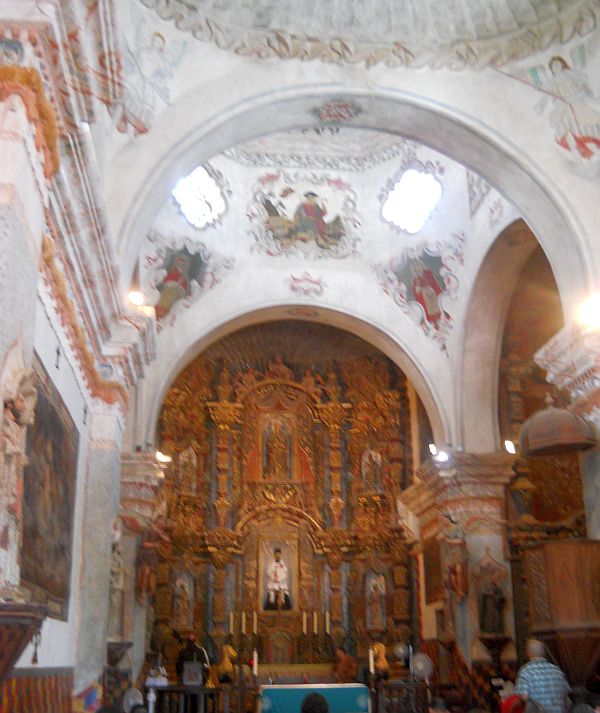
The mission was founded in 1692 by Father Eusebio Kino, a Jesuit. Construction on the current church stated in 1783 and ended fourteen years later The church, with its main entrance in wood, seems very large from the outside, but a lot narrower on the inside. The inside has the typical domed ceilings of Catholic cathedrals. The altar and backdrop are made of wood. Pews are a rustic wood.

A museum occupies several rooms to one side. These rooms were once used as sleeping quarters for the priests and nuns who ministered to their parishioners.

Inside the mission church
This section of Arizona was part of New Spain when the current church was built. The priest at the time borrowed money from a Sonoran farmer to pay for its construction. The mission is made of clay, brick and mortar. Cacti and other native vegetation fill a garden area in front.

San Xavier became part of Mexico when it declared its independence from Spain. San Xavier became part of the United States through the 1854 Gadsden Purchase. Nuns with the order of St. Joseph of Carondolet opened a school at the mission in 1872, The school is now operated by the Sisters of Charity.

The mission became a national historic landmark in 1963.

Sunday masses are at 7 a.m. and 10 a.m. Pictures may not be taken inside the church when mass is being held.

Admission to the church is free, though donation boxes abound. The church is located just off Interstate 19, which runs between Tucson and Nogales. The mission is visible from the freeway. Take exit 9 and follow the signs.